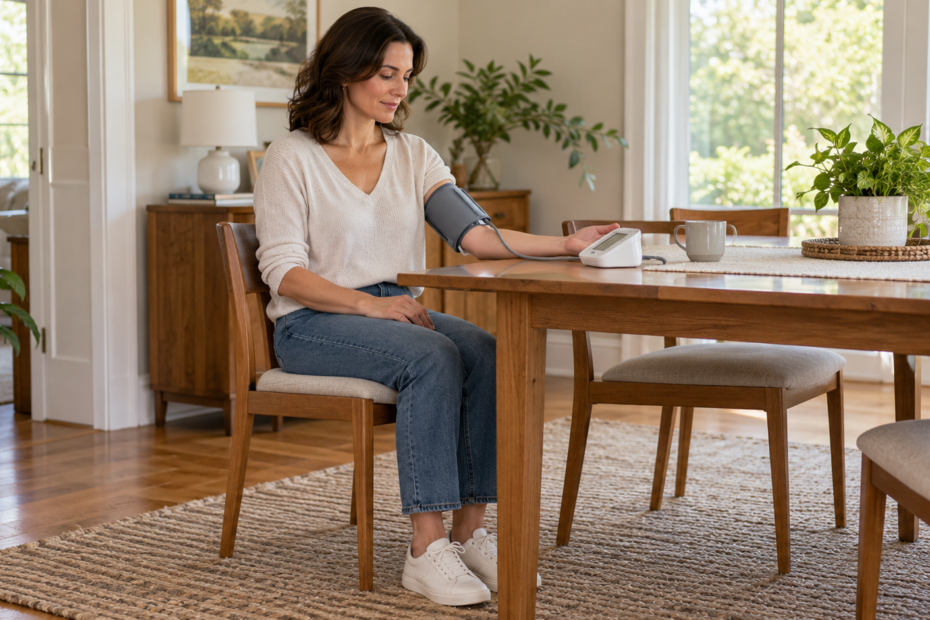
A home blood pressure monitor can help you understand what happens between medical appointments. However, an accurate result depends on more than pressing a button. Your posture, cuff size, recent activity, and the way you record readings can all affect the information you share with your healthcare team.
The goal is a repeatable routine that produces useful measurements. You do not need to chase a perfect number or check constantly. Start with suitable equipment, learn the technique, and agree with your clinician on when and how often to measure.
Choose a monitor that fits your arm
An automatic upper arm monitor is generally a practical choice for home use. Choose a validated device and check that its cuff covers your measured arm circumference. A cuff supplied in the box will not necessarily fit every adult.

The American Heart Association’s home monitoring guidance explains equipment selection and correct use. Bring your monitor to an appointment so your healthcare team can check your technique and compare its results with their equipment.
If you are pregnant, have an irregular heartbeat, or need another special consideration, ask which device is appropriate. A convenient monitor is useful only when it suits the person using it.
Prepare before you press start
Give yourself a quiet window rather than taking a reading immediately after rushing upstairs. Avoid smoking, caffeine, and exercise for at least thirty minutes beforehand. Empty your bladder, then sit quietly for at least five minutes.
Follow your clinician’s instructions about measurement timing, particularly around medication. Do not delay, skip, or change a prescribed dose simply to influence the result. If mornings are chaotic, discuss a practical schedule you can maintain.

Put the monitor, notebook, and a pen in the same accessible place. Reducing setup makes it easier to follow the routine consistently instead of improvising in a different chair every day.
Set up your chair, feet, and arm
Sit with your back supported and both feet flat on the floor. Keep your legs uncrossed. Rest the measured arm on a stable surface so the cuff is around heart level, with the muscles relaxed.
Place the cuff on bare skin according to the manufacturer’s positioning instructions. Avoid rolling a tight sleeve above it, since that can compress the arm. Keep still and quiet during inflation, including conversations on your phone.
The CDC’s blood pressure measurement guide illustrates the setup. A chair beside a suitable table often works better than trying to balance your arm on a sofa cushion.

Common mistakes and simple corrections
| Mistake | Better habit |
|---|---|
| Measuring after rushing | Rest quietly before starting |
| Using an unsuitable cuff | Match cuff size to arm circumference |
| Letting the arm hang down | Support it at heart level |
| Talking during inflation | Stay still and silent |
| Recording only the lowest result | Keep the complete agreed set |
| Changing medicines yourself | Discuss readings with your clinician |
Take repeat readings without chasing a number
Take two readings at least one minute apart unless your healthcare team gives different instructions. Record both measurements. A first result that surprises you is a reason to check your technique, not to continue indefinitely until something reassuring appears.
Use the same arm and similar conditions as directed. Avoid changing chairs, crossing your legs, or answering messages between measurements. If the device reports an error, consult its instructions before assuming that the number reflects your blood pressure.
A brief written note can explain unusual circumstances, such as recent pain or a disrupted night. Keep the description factual rather than deciding that one factor definitely caused the result.
Make your blood pressure log useful
Record the date, time, both readings, and any symptoms. Include medication timing if your clinician requests it. A simple notebook can work as well as an app, provided the information is complete and easy to share.
Ask when the team wants your results and how to contact them if readings exceed your agreed limits. Bring the log to follow-up appointments. Patterns across properly measured readings are more informative than an isolated screenshot.
Before your next appointment, ask which readings should trigger a phone call, who reviews your log, and how quickly you should expect a reply. Having that plan written down can prevent uncertainty when an unfamiliar number appears outside normal office hours while monitoring at home.
Home monitoring supports medical care; it does not replace diagnosis or a treatment review. Targets can differ according to your circumstances, so avoid treating someone else’s recommended number as your personal prescription.
Know when a high reading needs urgent help
For adults who are not pregnant, a systolic reading of 180 or higher, or a diastolic reading of 120 or higher, needs prompt attention. If you feel well, wait at least one minute, repeat the measurement, and contact a healthcare professional immediately if it remains severely elevated.
If a very high reading accompanies chest pain, shortness of breath, weakness, vision changes, or difficulty speaking, call your local emergency number immediately. Do not keep measuring while delaying help. The AHA’s emergency guidance explains this distinction. Pregnancy requires separate advice and thresholds.
Conclusion
Reliable home blood pressure monitoring begins with a suitable cuff, a quiet rest, supported posture, and a complete log. Build a routine with your healthcare team and use the results to guide conversations about care. Consistency makes the monitor more useful than frequent unplanned checks.
Can I measure over a thin shirt?
Place the cuff against bare skin according to the device instructions. Clothing can interfere with positioning and fit. Choose a loose sleeve that moves away without squeezing the upper arm.
Should I stop medicine when home readings improve?
No. Continue treatment as prescribed and discuss the results with your clinician. Better readings may reflect treatment working. Changing medication without advice can create avoidable risks.
How often should I check my blood pressure?
Ask your healthcare team for a schedule based on why you are monitoring. They may want a limited series of morning and evening readings or another plan. More frequent checking is not automatically more useful.

Why Your Knees Secretly Crave This Underrated Exercise

Why These Common Phrases May Signal You’ve Quietly Given Up on Happiness

Why China’s Ocean-Bound Data Center Is Making Waves in Tech

Did You Know These Veggies Are Secretly Related?
Why Leaving Vinegar Out Overnight Transforms Your Home’s Air